Cultural stigma about menstruation is found globally, manifesting in many different ways, including period poverty in the UK and exclusionary and discriminatory practices all over the world. There is a growing body of work on addressing menstrual stigma, with global activist communities increasing debate in the public and political realms. Menstrual art (sometimes called Menstrala, a term coined by the artist Vanessa Tiegs back in 2000), has a long history and over time has aimed to subvert the dialogue, stigma, and taboo surrounding periods.
Here are five artists that are tackling these issues head on by using menstrual blood in their work and making periods visual, depicting the visceral experience it is.
- Rupi Kaur
The famous Instagram poet was banned and then unbanned in 2015 for her posts showing menstrual blood and everyday menstrual experiences. Examples include photographs of her lying in bed with blood-stained pajamas and sheets. Her response, beautifully written, exposes the current misogynistic undertones that still exist in society, as evidenced by their removal of her posts. You can view the full series at rupikaur.com.
In response to the removal of her art, she wrote, “thank you @instagram for providing me with the exact response my work was created to critique. you deleted a photo of a woman who is fully covered and menstruating stating that it goes against community guidelines when your guidelines outline that it is nothing but acceptable. the girl is fully clothed. the photo is mine. it is not attacking a certain group. nor is it spam. and because it does not break those guidelines i will repost it again. i will not apologize for not feeding the ego and pride of misogynist society that will have my body in an underwear but not be okay with a small leak. when your pages are filled with countless photos/accounts where women (so many who are underage) are objectified. pornified. and treated less than human. thank you. this image is a part of my photoseries project for my visual rhetoric course…. i bleed each month to help make humankind a possibility. my womb is home to the divine. a source of life for our species. whether i choose to create or not. but very few times it is seen that way. in older civilizations this blood was considered holy. in some it still is. but a majority of people. societies. and communities shun this natural process. some are more comfortable with the pornification of women. the sexualization of women. the violence and degradation of women than this. they cannot be bothered to express their disgust about all that. but will be angered and bothered by this. we menstruate and they see it as dirty. attention seeking. sick. a burden. as if this process is less natural than breathing. as if it is not a bridge between this universe and the last. as if this process is not love. labour. life. selfless and strikingly beautiful.”
- Judy Chicago
In the 1970s, radical feminist artist Judy Chicago made Red Flag (1971), a photolithograph of the artist removing a bloodied tampon from her vagina. The following year, Chicago created “Menstruation Bathroom” (1972), an installation featuring a white bathroom with shelves of menstrual products, an overflowing trash can of used sanitary pads, and a clothesline of pads leaking blood onto the otherwise spotless floor, forcing periods to be visible.
- Casey Jenkins
In “Casting Off My Womb” (2013), Casey Jenkins, spent 28 days weaving a scarf using yarn that she inserted inside her vagina daily. She knit through her menstrual cycle, soaking the yarn with her blood, in order to explore “the dissonance between an individual’s quiet desires” and the “intense community expectations regarding what they should do with their body.” The resulting media attention led to a public backlash and thousands of hateful Internet comments.
- Bee Hughes
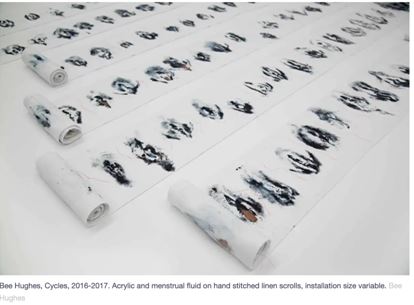
Cycles (2016-17) (pictured left) captures the idiosyncratic rhythm of the artist’s body — its shifting forms and bodily fluids. It is a document of a changing menstrual cycle. The work is a direct and public challenge to the stigma of menstruation as well as the notion that all periods conform to the medical textbooks or that all women experience menstruation the same way.
- Poulomi Basu
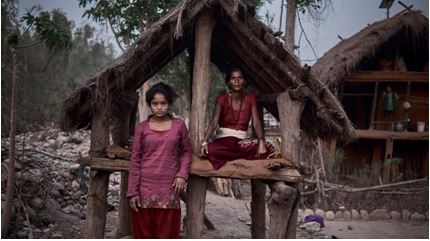
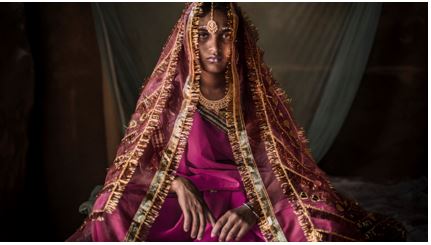
Poulomi Basu’s A Ritual of Exile: Blood Speaks explores exclusionary rituals and practices in Nepal. She uses immersive virtual reality to evoke emotions and to turn audiences into activists. You can view some of her work below and here.