When it comes to options for dealing with our periods, the women of 2014 are generally pretty fortunate. Technology has advanced rapidly in a relatively short period of time offering more options for menstruating women on the move, particularly as a response to more women in the workforce.
In honor of Women’s History Month, we wanted to take a look back at the history of sanitary napkins and tampons. When and how did they become a readily available product? According to the book, Everything You Must Know About Tampons (1981), tampons have been around for centuries:
“The oldest printed medical document, papyrus ebers, refers to the use of soft papyrus tampons by Egyptian women in the fifteenth century B.C. Roman women used wool tampons. Women in ancient Japan fashioned tampons out of paper, held them in place with a bandage, and changed them 10 to 12 times a day. Traditional Hawaiian women used the furry part of a native fern called hapu’u; and grasses, mosses and other plants are still used by women in parts of Asia and Africa.”
Talk about green feminine hygiene! Ancient women also used similar materials for pads such as cloth, animal skins, grass and sponges. Our ancestors had no choice but to use what nature provided. (Updated: We also must acknowledge that many women in less-industrialized or remote parts of the world are still using these types of materials.)
So how did we go from papyrus and moss to pads with wings and tampons with applicators?
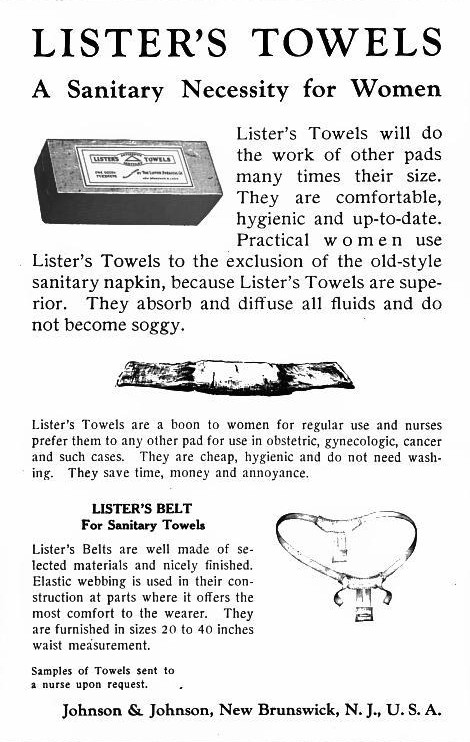

Pads have only been sold in the United States since 1896 and tampons subsequently since 1936. The first sanitary napkins were called “Lister’s Towels” after pioneering scientist Joseph Lister. Yup the Listerine guy. However, these weren’t widely used because it was taboo to advertise and publicly address menstruation. Also, many women could not afford to buy them, so instead they made their own from materials like cotton and cheesecloth because they were readily available and cost-effective.
At the same time, for women who could afford these products, it was illegal to mail disposable sanitary napkins and tampons in the United States. Because of the Comstack Laws, passed in 1873 but lasting for decades, banned the mailing of any “pornography or contraception-related” materials, sanitary products and contraceptives had to be re-branded as “feminine hygiene.” This really only affected well-to-do women who could afford luxuries such as disposable sanitary products and the postage to have them mailed.
World War I bandages actually paved the way for commercial selling of pads. Kimberly-Clark created Cellocotton, a synthetic cotton, to treat and bandage soldier’s wounds. However, it was so absorbent that nurses in France started to use them for during their cycle. Because of this discovery, six years later the “feminine hygiene” industry took off.
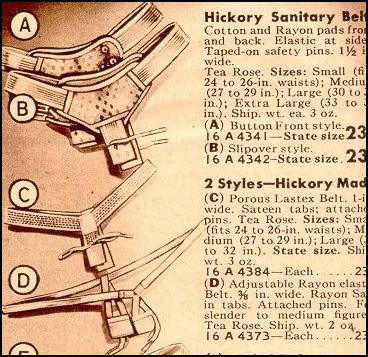
Even though pads were now readily available, there weren’t the most comfortable to wear. Women used to have to wear sanitary belts to hold their pads in place. These were not fashionable at all but instead were contraptions that kept pads secure.

Commercial tampons were available in the late 1920’s and early 1930’s but did not become mainstream until the invention of the tampon applicator. During World War I, a young employee of Kimberly-Clark stuffed a condom with the Cellocotton and poked holes in it, as a prototype for tampons. But it wasn’t until 1931 when Dr. Earle Hass patented the tampon applicator, that tampons became marketable. It was innovative for that time because American women generally were uncomfortable manually inserting a tampon. It was taboo to be so intimate with their vaginas and menstrual blood. Some Catholics and devout Christians gave tampon use a sexual context and feared it would break the hymen. Nowadays I think it’s pretty clear that most of us aren’t getting off from our tampons.
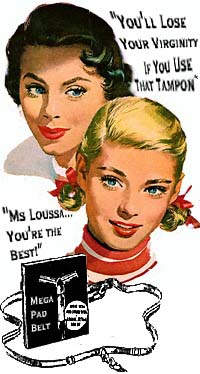

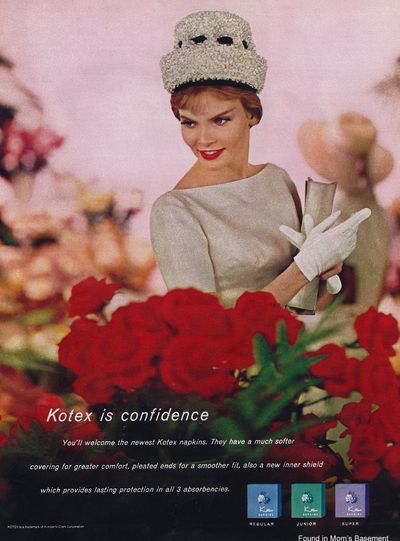
Throughout the 1930’s and through the 1950’s, advertising of women’s hygiene products remained discreet. Johnson & Johnson created silent coupons where women could hand them to a cashier and get her pads in an unmarked box. Or there would be a nondescript money box on the counter specifically where women could pay, and the cashier would give them their pads. In the 1960’s, magazine ads used glamourous images as taboos changed and they wanted to broader reach.

The next major achievement was when then first adhesive sanitary pad became available in the early 1970’s. Pretty recently, right?! That meant no more belts or sanitary underwear. Around the same time, scented pads and tampons were being introduced into the market, using dangerous chemicals to again capitalize on women’s shame.
Today many women still use cups, sea sponges and other materials to avoid absorbing chemicals through our coochies. However, it is more convenient for many women to use disposable sanitary pads and tampons because they are comfortable, relatively dependable and portable. We are taking a cue from our foremothers by using only natural and eco-friendly materials for our products. Not only are they 100% certified organic and natural cotton and chlorine/dioxin free which is healthier for our lady parts, they are synthetic free and thus irritation free even for those with the most sensitive skin.
What a journey it’s been as now American women can speak more candidly about our bodies, our periods and our sexual health. We look forward to keep pushing these conversations and contributing more natural and eco-friendly products for all of you green queens!