If your period has ever stolen your sleep, wrecked your confidence, or made you feel like a completely different person for a few days this is for you. Because here’s the truth: period symptoms don’t stop at cramps. They can follow you into the night, into your mood, into your mirror, and into how you show up at work, with friends, or even in your own skin. And yet… we barely talk about it. Let’s change that.
Why Periods Mess With Sleep (More Than We Admit)
Ever had one of those nights where you’re exhausted but your body won’t let you rest? You’re not imagining it. Studies suggest 30% to 70% of women experience sleep changes during PMS or menstruation. Some deal with insomnia restless thoughts, cramps, anxiety, or waking up every hour. Others feel the opposite heavy fatigue, daytime sleepiness, long naps, and brain fog. Sometimes, you can swing between both in different cycles.
What’s actually happening?
Hormones play a huge role.
-
Progesterone can feel calming and sedating for some people.
-
But when progesterone drops sharply right before and during your period, sleep can get disrupted.
-
Add in cramps, bloating, mood shifts, headaches, or low iron-related fatigue, and bedtime becomes a challenge.
The part no one says out loud
If a predictable monthly cycle caused sleep disruption for most men… would it still be dismissed as “just a few bad nights”? Wouldn’t sleep medicine treat it as a major field of research? Instead, menstrual-related sleep issues often get brushed off as “normal,” which is a polite way of saying: live with it.
Why This Matters More Than Sleep
Sleep isn’t just sleep. It affects everything. When your rest is disrupted:
-
Anxiety can spike
-
Patience drops
-
Mood swings feel more intense
-
Focus and productivity decline
-
Your pain tolerance gets worse (yes, really)
So if we want better mental health, better work performance, and better quality of life, menstrual sleep struggles deserve real attention not eye-rolls.
Quick self-check
If you consistently struggle to sleep during PMS or your period, it’s worth tracking:
-
When it starts (days before bleeding?)
-
What you feel (pain, anxiety, temperature changes, night sweats)
-
How many times you wake up
-
How you feel the next day
Patterns can be powerful and validating.
“Menstrual Esteem”: Why Periods Still Make Women Feel Ashamed
Now let’s talk about something quieter, but just as real: confidence. Have you noticed how many women feel less attractive or “off” during their period Bloating, acne, breakouts, tenderness, low energy… it’s not uncommon to:
-
Avoid plans
-
Cancel workouts
-
Pull back socially
-
Feel uncomfortable in your clothes
-
Lose interest in intimacy
Experts sometimes call this low menstrual esteem when self-confidence dips during the cycle.
Here’s the deeper issue:
That drop isn’t only biology. It’s cultural conditioning. We’re taught (directly and indirectly) that periods are:
-
“gross”
-
“dirty”
-
something to hide
-
something that should be “discreet”
Even the language around period care often implies secrecy. And when your body is treated like a problem to conceal, it’s hard to feel confident inside it.
The big question
Why should a natural, life-sustaining process still make women feel embarrassed in 2025?
If periods are normal, why are so many women still made to feel like they’re not?
What We Actually Need: Better Products + Better Conversations
Real support means addressing both:
-
the physical experience (sleep, comfort, irritation)
-
the emotional experience (shame, confidence, body image)
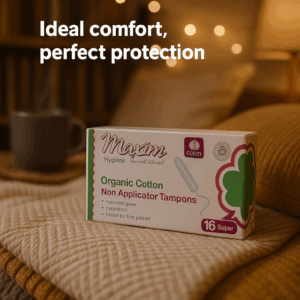
At Maxim Hygiene, we believe period care should feel like care not a chemical experiment and not a confidence killer.
Many women are now choosing clean, fragrance-free, breathable cotton options because the skin in intimate areas is sensitive and irritation can make everything worse (including sleep).
When your products feel gentler, your body often feels calmer. And when your body feels calmer, sleep and self-esteem can improve too.
Let’s Talk About It (Because Silence Doesn’t Help)
Before you go, here are three questions worth asking and answering honestly:
-
Should sleep disruption during periods be recognized as a real medical concern, not “just bad nights”?
-
Do cultural attitudes around menstruation fuel body image struggles and anxiety?
-
What would change if we treated menstruation as normal not something to hide?
If this resonates, share it with someone who needs the reminder:
You’re not dramatic. You’re not alone. And you’re not “too sensitive.”
Your cycle affects your whole life and it deserves real support.